Showing posts with label stories. Show all posts

04 April 2014

Bud, Not Buddy: 2000 Newbery Award Winner

The beginning of March 2014 I started a new undertaking: reading every single Newbery Medal Winner book. A number of them I have read in the past, but I am reading them with fresh eyes,and reviewing them for others. I am not reading them in order, as some will require some effort on my part to find them all.  Want to keep track of which books I read?  Check them out at Confessions of a Wannabe Reader!

Bud, Not Buddy.jpg
Cover of the book - The image is used for identification purposes only under the fair use clause.

Bud Caldwell: The Boy on the Lam

"Rules and Things Number 39: The Older You Get the Worse Something Has to Be to Make You Cry"

At the height of the Great Depression, orphaned Bud Caldwell is ten years old and has lived in a number of different foster homes.   At least he did until he picked a fight with a foster brother and ran away.  His mother died when he was 6, and he doesn't know anything about his father, save that he was a musician, perhaps the famous musician Herman Calloway.  His mother had several flyers of Herman's bands. Carrying everything he owns in a beat up suitcase that he has to close with a piece of rope, Bud decides to head 120 miles on foot to Grand Rapids, Michigan, which is where Herman Calloway lives.  Along the way, he discovers that the rules he has established in his young life ring true, and that family is something that is made by more than just the bonds of blood.

I have read Bud, Not Buddy by Christopher Paul Curtis several times, and the short book is very touching.  Its a story of longing and belonging.  Bud longs for his lost mother.  Herman Calloway longs for his lost daughter.  It is also a story of growing up in a very trying time, as the Great Depression touched many lives in very hard ways. Children were forced to grow up faster and accept responsibilities for themselves even when they were not mature enough to do so.  Unlike other books I had read about the Great Depression, like Moon over Manifest and No Promises in the Wind by Irene Hunt , this one was unique in that it was told from the viewpoint of an African American child instead.

Just as the story of the Great Depression was not neatly resolved, the ending of this novel is not resolved in a neat and tidy ending, but one is left hoping that there are good things coming to Bud.

26 March 2014

Sounder: 1970 Newbery Award Winner

The beginning of March 2014 I started a new undertaking: reading every single Newbery Medal Winner book.  A number of them I have read in the past, but I am reading them with fresh eyes,and reviewing them for others. I am not reading them in order, as some will require some effort on my part to find them all.  Want to keep track of which books I read?  Check them out at Confessions of a Wannabe Reader!

Sounder.jpg
Cover of the book - The image is used for identification purposes only under the fair use clause.


Sounder: The Loyal Dog

Sounder by William H. Armstrong is a story about a sharecropping man, his son, and his wonderful hound dog Sounder.  When the man is arrested and taken away, Sounder tries to save him, resulting in his wounding.  But the dog lives, as  the result of careful tending by the son and his mother.  The son, only known as the boy, tries to find his father and find a way for his family to survive without the man of the house. 

This book depressed me, and I struggled to finish reading it.  As far as value as historical fiction goes, this was a great story of life as a poor Negro sharecropper.  There is much pain and suffering in this short novel, and while some of the characters seem content with their lot in life, it seemed harsh and saddening.  The only character named in the story is the dog, Sounder, who is named for the way his bark sounds through the woods.  

After reading some of the other Newbery Medal books lately and feeling uplifted at the end of the reading, I felt like I was kind of let down by Sounder.  While the boy does achieve his goals and there is a slight hopefulness to the end of the book, there also a feeling of injustice and discontent. 

The Graveyard Book: 2009 Newbery Medal Winner

The beginning of March 2014 I started a new undertaking: reading every single Newbery Medal Winner book.  A number of them I have read in the past, but I am reading them with fresh eyes,and reviewing them for others. I am not reading them in order, as some will require some effort on my part to find them all.  Want to keep track of which books I read?  Check them out at Confessions of a Wannabe Reader!

TheGraveyardBook Hardcover.jpg
Cover of the book - The image is used for identification purposes only under the fair use clause.

Nobody Owens: The Living Boy 

‟I know my name,‟ he said.  ‟I'm Nobody Owens.  That's who I am."

A toddler wanders through a graveyard, oblivious to the fact that he is the only one of his family still alive, oblivious to the evil that pursues him.  For nearly fifteen years, Nobody, nicknamed Bod, lives in an old London cemetery.  He is the only living soul, raised by the otherworldly inhabitants as their own.  He is taught basic skills such as reading and writing and history, as well as ghostly skills of fading and haunting.  He discovers the ways of the living and prepares to deal with the evil that stalks him with the help of his ghost parents, the friends of the graveyard, and his mysterious guardian, Silas, who lives in the dark. 

This book was unlike any children's book that I have ever read.  The ghost stories alone would have given me nightmares as a child.  The first chapter has a grisly murder scene in it, making this book a book that is not for the faint of heart, but a great story for anyone who loves suspense and fantasy.  I did enjoy this story immensely.  The Graveyard Book by Neil Gaiman utterly fascinated me with its supernatural aspects and its descriptions of the characters as well as its original storyline.  The story is about wanting to belong; Bod wants to belong with his ghost family as well as with humans, while each of the ghosts wish they had ways of belonging when they were alive. 

19 March 2014

Walk Two Moons: 1995 Newbery Award Winner

The beginning of March 2014 I started a new undertaking: reading every single Newbery Medal Winner book.  A number of them I have read in the past, but I am reading them with fresh eyes,and reviewing them for others. I am not reading them in order, as some will require some effort on my part to find them all.

Since I am on spring break this week, there will be more postings than usual.


Walk Two Moons.jpg
Cover of the book - The image is used for identification purposes only under the fair use clause.

Salamanca Tree Hiddle: Storyteller and Searcher

"Don't judge a man until you've walked two moons in his moccasins."

Thirteen-year-old Salamanca "Sal" Hiddle is an only child whose mother has left.  Her father has uprooted her from her home in Kentucky and moved to Ohio, where Sal must learn to fit in amongst a group of extraordinary characters.  During the summer, her paternal grandparents scoop her and drive cross country to Idaho up to reunite her with her missing mother.  Along the way, Sal weaves a story of her new friends and the adventures that they have, particularly her friend Phoebe Winterbottom, whose own mother disappears and who discovers a "lunatic".

I just finished reading Walk Two Moons by Sharon Creech.  It seems lately that the Newbery Award books I have been reading all revolve around one or both parents that are missing or dead, and this story is no different.  Sal wishes her mother hadn't abandoned her, and spends most of the trip wishing her mother was with her now.  The weaving of the various stories, all revolving around mothers, was done very well.  The interspersing of Native American ideals (or Indian, as Sal prefers to identify herself) added another dimension to this tale.  The theme of this novel is grief.  Sal grieves being abandoned and being uprooted from all she knew while others grieve in different ways that make sense if you have read the novel.  Another theme is alienation and isolation, as most of the mothers in this story share in those feelings. 

18 March 2014

A Wrinkle In Time: 1963 Newbery Award

The beginning of March 2014 I started a new undertaking: reading every single Newbery Medal Winner book.  A number of them I have read in the past, but I am reading them with fresh eyes,and reviewing them for others. I am not reading them in order, as some will require some effort on my part to find them all.  Want to keep track of which books I read?  Check them out at Confessions of a Wannabe Reader!

Cover of the book - The image is used for identification purposes only under the fair use clause.

Meg and Charles Wallace Murray: The Misfits

"We tesser.  Or you might say, we wrinkle".

Throughout her life, Meg Murray felt as though she didn't fit in, that her little brother, Charles Wallace, didn't fit in either, and that everyone else was easily able to conform to society's norms.  While her mother and twin brothers can act the part, she and her little brother have nothing in common with the.  So she is surprised one day to find that the popular athlete, Calvin O'Keefe, also feels like an outcast. Add to that the mystery of her father's disappearance and the sudden arrival of three very odd stranger to their town and Meg doesn't know what's serious and what's not.  When the mysterious strangers discuss that there is a wrinkle in time and that Meg's father is caught in it somehow, Meg finds herself journeying with Charles Wallace and Calvin on a very strange and wondrous journey to find her father.

I had never read A Wrinkle in Time by Madeleine L'Engle before stating this undertaking.  I had been told I would love it, but just never had the inclination to read it before this.  In fact, I had never read a single one of her books, which may surprise some of my friends given that I love fantasy and science fiction works.  Having just finished the book, I found that I really enjoyed it once I got into it.  I have to admit it did take me a good number of chapters to really be able to get into reading this book.  So much of A Wrinkle in Time reminded me of the works of J.R.R. Tolkien's Lord of the Rings trilogy and C.S. Lewis' Space Trilogy that I found myself pulled in. Knowledge and light overtaking darkness is a major theme of this book.  Love also is a theme of the novel and one could argue that this is an allegory of the Christian faith, such as many of C.S. Lewis' fiction books.  This is not surprising given that L'Engle was Christian. It is a great fantasy read as well, for those who enjoy the previously mentioned trilogies.  Perhaps after I am done with my project I will read the rest of her books, as A Wrinkle In Time is the first in a long serious of books dealing with the Murray and O'Keefe families.


14 March 2014

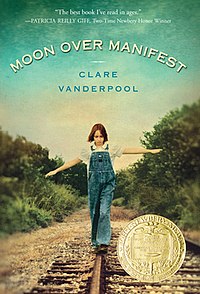
Moon Over Manifest: 2011 Newbery Award

I have started a new undertaking: reading every single Newbery Medal Winner book.  A number of them I have read in the past, but I am reading them with fresh eyes,and reviewing them for others. I am not reading them in order, as some will require some effort on my part to find them all.

Moon Over Manifest book cover.jpg
Cover of the book - The image is used for identification purposes only under the fair use clause.

Manifest: To Reveal or to Make Known
"If there is such a thing as a universal..... it's that there is power in a story."  

Twelve-year-old Abilene Tucker knows one thing for certain, even if everyone else doubts it; her father will return,at the end of summer to get her.  At the height of the Depression, Abilene is sent to the town of Manifest, Kansas to spend the summer with friends of her father.  She arrives in time for the last day of school and receives an assignment from the solitary schoolteacher: write a story.  Abilene spends the summer figuring out just what her story is, as well as finding out the story of the town of Manifest.  Throughout her journey, she learns that she is helping to heal a town, and that loving and being loved both leave scars.

I read Moon Over Manifest by Clare Vanderpool without knowing anything about either the book or the author.  Perhaps that was a good thing, because I did not have any notions about what I might be reading and were able to discover both the author's storytelling ability and the story itself..  The story spans two distinct times in American History, as it covers both the end of World War One and the Spanish influenza epidemic as well as the middle of the Great Depression, when people had given up hope.  Being a History buff, the stories that are woven through the main plot were fascinating and brought to life an era that is often times drab and dreary for me.

Needless to say, I thoroughly enjoyed this book, and was captivated until the end by the themes of hope and hopelessness, of belonging and loneliness, of the story.   Clare Vanderpool was able to tell a story that is universal.  Like Roll of Thunder, Hear My Cry, this story tells of heartbreak during the depression, but unlike the former, Moon Over Manifest was able to leave me feeling like something good is coming to the characters.  There is a power in this story.

27 March 2012

Pets are Family too!

My cat, Twix, has a fascination with my walk-in bedroom closet.  She meows to get inside it just about every time we're changing and has on occasion gotten locked inside the closet because we didn't know she was in there and shut the door.
My great uncle Bill hugging the family dog, early 1900s

In researching family trees, pets are often overlooked.  But talking about them can bring the best memories to light.   My dad has said he's never liked cats, but yet we had a cat when I was a baby, proof below, and another when I was growing up in Southern California.

Tigger, my dad, and baby me
When I was a baby, my parents also owned a Labrador dog named Lucas that guarded me and taught me how to walk.  He was a sweet dog but super protective of "his" baby.  He was killed when he was hit by a car.  A neighbor had let him out.

My maternal grandparents owned a dog by the name of Whiskey.  He was a terrier of some sort and a small dog, but I could remember him being mean, or maybe he was just annoyed by the little kids that bugged him (myself included).  He loved only my grandfather, and I know my parents have a picture of Whiskey sitting on Grandpop's lap.

My aunt, uncle, dad and PeeWee at Christmas in the 60s
My dad's family had a dog named PeeWee.  He was featured prominently in family pictures as another one of the kids and was well loved by my dad and his siblings. 

And again at Easter
My great-grandparents had a cocker-spaniel named Rusty that they loved to walk.  The dog was rusty colored and mean to some of the grandchildren that were almost always at the house, and actually snapped at one of my mother's cousins when she was a child.  He was stopped by a command from my great-grandfather.  That stories sparked a conversation that opened up a flood of memories about a generation that has been gone for over 50 years. 

A cousin's dogs in 1951
Pets are a large part of our lives in the present.  Why can't they also be a part of our past as well?  So often converations about pets are limited when interviewing people about their family history.  Sometimes a mentioned pet will bring a smile to someone's face and start an entire conversation of happy moments in a family members life.  Even thinking backon my own life, I find myself smiling over pets I have had:

Besides Lucas and Tigger the cat, there was Woo-Woo the white labrador that was a bit of a pet.  There was Grouchy, our lab-cocker mix that we had from the time I was five until well into high school who loved to eat crayons and tinsel and was anything but grouchy.  There was Charlie, the loveable mutt and the only dog to ever bite me, though he didn't mean to. (My brother, on the other hand, seems to have been a dog-bite magnet, having been bitten by at least three dogs in his childhood). There was Boo-Boo Kitty, the ferocious tom-cat who loved pick fights with possums and other cats as well as curl up in a lap and sleep.  There was Moses, the stray we had for a month before he passed away.  There was Tigger the orange tabby that my husband and I owned for a year before we had to give him away.  There was also the countless numbers of fish and bugs and other small creatures that my siblings and I owned growing up, including a salamander and a crawdad.

My two cats, Barbossa and Twix
There are also the present day animal family members.  There is Moose, my parents' lovable and old labrador-mastiff mix that enjoys a warm spot and getting all the attention he can and has been with my parents since I was a senior in high school.  And of course, there are my wonderful cats Twix and Barbossa who live with me now.  My sister also owns two crazy and loveable terrier dogs.  They are all members of my family, and offer as much love and affection as the human members do.