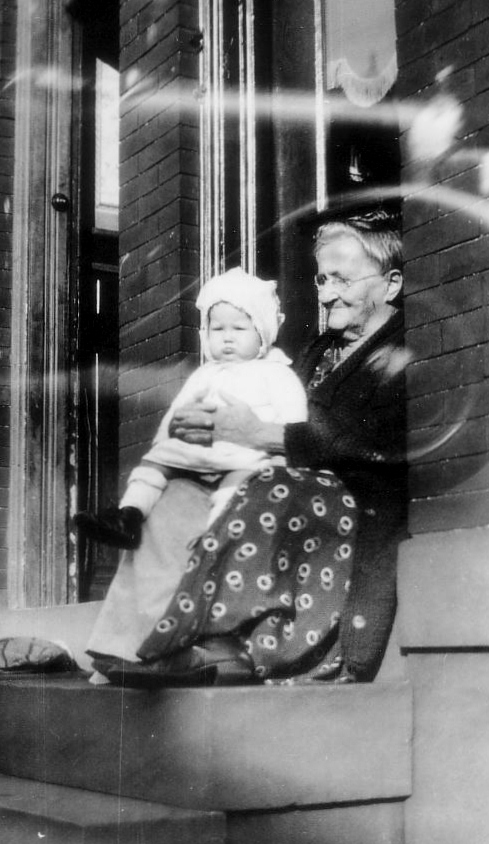
Occasionally I tend to focus on some of the notable women in my family tree and since re-starting this blog I wanted to write about their stories. One such woman was my maternal second great grandmother, Marie Elizabeth Hans Waldspurger. This is her story.
 |
| Photograph of Marie Elizabeth Hans Waldspurger. Personal collection of the blogger |
Marie Elizabeth Hans was born 28 November 1850 in the tiny hamlet of Wibolsheim, which had been absorbed by the larger commune of Eschau, which is in the arrondissement of Strausbourg, in Bas-Rhin, Alsace (now part of the administrative region of Grand Est, France). She was the second youngest daughter of Mathias Hans, a day laborer, and his wife Elizabeth Kintz. Having been born Catholic, she was likely baptized at
Église Saint-Trophime, the parish church, though records are not available for that church online. Her birth was registered in the civil registrations of the day, and was noted as happening at two in the morning.
Elizabeth, which was what she went by, can be tracked via the recensements de la population for Eschau until 1866, which was the last recensement done by France for her area. After that, the region was part of Germany, having been lost to France during the Franco-Prussian War. Elizabeth most likely saw some of the atrocities of war and its battles, having been so close to Strasbourg and Erstein. In
another blog post, I wrote about the war and its effect on the area, and on Erstein in particular, which was where Elizabeth's husband hailed from. I have not yet done research on the rest of the Hans family to see if they were affected by any deaths due to the war.
 |
| Florian Waldspurger. Personal collection of the blogger |
On 15 May 1877, Elizabeth married Florian Waldspurger in Erstein, a commune just eleven kilometers from Eschau. He was a stocking maker five years her senior who was born in the commune of Erstein. How the couple met is unknown, but the marriage was likely one of necessity, as Elizabeth was four months pregnant with their eldest son.
On 11 October 1877, Elizabeth gave birth to her firstborn, a son named Edward. A little over a year later, on 19 December 1878, the couple's second child, Eugene, was born.
Florian, according to family stories collected from his descendants, was not able to reconcile France's loss in the Franco-Prussian War, nor did he wish to serve in the German military or have his sons serve. So the family took steps to start immigrating to the United States. Florian left first, and arrived in steerage on the steamer Saint Laurent, which sailed from Le Havre on 3 April 1880 and landed 11 April 1880. Passengers appeared to have been processed through on the 13th. His place of origin according to the manifest was France.
Elizabeth soon followed with the two boys, leaving on the
Amerique (click to see an image of the steamship), which arrived in New York on 7 July 1880. She, Eugene and Edward traveled with a F. Waldspurger, assumed to be Florian's younger brother, Francois. Elizabeth was pregnant again, and the travel was hard, as the following appeared in a New York City newspaper:
"The steam-ship Amerique, which arrived from Havre yesterday, met with very bad weather on the 4th and 5th. A dense fog which had prevailed for some 48 hours cleared up, and was followed by squalls of extreme violence which caused a very heavy sea, and the huge waves frequently swept over the entire forward port." ~"Abandoned Vessels and an Iceberg," shipping news, The New York Times (New York, New York), 8 July 1880, page 8
There is some confusion on the ship's manifest for this family, as F. Waldsburger is listed as hailing from Switzerland, Edward is listed as being 7 years of age, but was actually 3 and was also listed as hailing from Switzerland, and Elizabeth and Eugene are listed as being from Alsatia Germany. Elizabeth is listed under the name Hans, which would make sense since France since the 1790 revolution listed women by their maiden names for life, and the trip originated in Le Havre, France. What is unusual is that Eugene is also listed as a Hans. Perhaps someone copied over the manifest incorrectly? Attempts to locate the original French port manifest have been futile, although some manifests do exist for other trips.
In 1881, the family lived at 630 Division Street in Camden, New Jersey, just across the river from Philadelphia. Family notes copied from daughter Mary Anna state that son Joseph, with whom Elizabeth was pregnant during the voyage, was born around this time, having been born 26 December 1880 and dying 1 September 1881. Official documents to support these family notes cannot be located as of yet, if they even exist.
Florian continued his work as a stocking goods maker, as there was a need to it in the new world as well. By 1882, the family had made their home in Trappe, Montgomery County, Pennsylvania, where Mary Anna was born on 26 July 1882. Their stay here was not very long, as by 1884 they were in the city of Philadelphia, where they took up residence at 522 Poplar Street. This was the house of residence where daughter Emily was likely born in October of 1884 and where children Ernest and Elizabeth Regina were born, in 1887 and 1890 respectively. The family attended S
t. Peter the Apostle Catholic church at this time. It was just a block away from where they lived on Poplar. It was here that Emily, Ernest and Elizabeth were all baptized and it was in the cemetery that the church created that Eugene and Emily were laid to rest.
Just a year after Ernest's birth in 1887, tragedy seemed to strike. On 23 January 1888, after trying to fight off typhoid fever, Eugene succumbed to the infection at the age of nine. He was buried the same day at St. Peter's Cemetery, also known as Richmond Cemetery, in the Port Richmond neighborhood of Philadelphia. Almost six months later, three year old Emily contracted diphtheria. She died from the infection on 11 June 1888 and was buried in the same cemetery as her older brother. Funeral services for both burials were provided by the Wackerman Funeral Home. It appears that nether grave is marked in the cemetery, as the family likely did not have sufficient funds to do so.
 |
| Photograph of Richmond Cemetery / St. Peter's Catholic Cemetery. Taken August 2017 by the blogger on a trip to Philadelphia |
In just seven years, Elizabeth had buried three of her children. Fortunately, the remaining five children did survive to adulthood, which given the contagion that both diphtheria and scarlet fever seem to possess, is a miracle.
In 1891, the family lived at 1325 Crease Street. Eldest Son Edward caused some worry when he fell down a hill while on a visit to Fairmount Park and struck his head on a stone. He was taken to the German Hospital, where he was treated for a concussion. Elizabeth was probably terrified at the thought of losing another child, but luckily he survived (it's a good thing too, because he's whom I am descended from!).
From 1893 until 1897, the family resided in a cottage in the Second Street Woods, a kind of unincorporated farmland area within the city limits. It was at this residence that the youngest child, Clara Agnes, was born on 6 June 1894 and baptized at
Saint Veronica's Church.
Around 1897, the family had scrimped and saved enough money to put a down payment on a farm, which had been Florian and Elizabeth's dream when they moved to the United States. Florian was also having some lung troubles from the soot and smoke that filled the air in Philadelphia, so his doctor had recommended the move to the country. So the family relocated to Tylersport, a community in Montgomery County, where Florian was able to buy a dairy farm for a reduced price because it was supposedly haunted. According to a letter written by Florian and Elizabeth's grandson, Don Best:
"An interesting note on buying the farm at Tylersport: It was offered at a very attractive price because there were rumors that it was haunted. Everytime a prospect would look it over, there were strange noises and rattling of chains in the house. Florian, not being superstitious, exposed the culprit: a neighborhood farmer in the attic who was trying to drive the price down even further! Florian caught him in the act." ~ Don Best, (Philadelphia, Pennsylvania) to Kelley Wood-Davis, letter, 10 April 2012
The family settled into the comfortable life of farming, and attended church at
Saint Stanislaus Catholic Church in Lansdale, Pennsylvania. This life of bliss was to be short lived.
Florian went to Philadelphia every month by train to pay the mortgage and collect money from clients who bought his dairy products. By now, son Edward was living in Philadelphia, and Florian liked to visit him while in the city as well.
The morning of 2 September 1900 was no different, though he was running a little late according to family stories. He boarded the morning milk train as it was starting to pull out of the station. when the train stopped at the Hatfield Train Station, calamity struck, as the
Hatfield Train wreck happened that fateful morning. Florian was decapitated in the ensuing wreck.
Elizabeth and the children home on the farm did not get word of the accident until the next day. Mary and Ernest were sent to identify their father's body, which was the last to be identified. All possessions of value that he had on him, including the cash he had to pay the mortgage and the list of who owed him money, were gone, as his body had been rifled with by onlookers seizing an opportunity in the chaos. He was buried 5 September 1900 at Saint Stanislaus Parish Cemetery in Lansdale.
 |
| Florian Waldspurger's headstone at Saint Stanislaus Catholic Cemetery, Lansdale, Pennsylvania. Photo taken June 2003 by the blogger. |
After the incident, Mary, Ernest, Elizabeth and Clara (since they were all minors at the time) were each awarded six hundred and sixty dollars from Philadelphia and Reading Railway Company in damages for causing the death of Florian Waldspurger. The children's share was put into trust for them, and as their mother, Elizabeth was entitled to the interest for use in raising them, which she gladly used.
Elizabeth tried to keep up with the demands of the dairy farm, but with only thirteen year old Ernest as manual labor at home, it was difficult. With most of the family's ready cash gone in the accident, it was hard to keep up with the day-to-day operations, and the agreement that had been made by the previous owner and Florian Waldspurger for purchase of the farm had been rescinded when Florian was killed. According to family stories, Elizabeth also had a nervous breakdown after Florian's death, likely due to the overwhelming stress of having to become the head of the household in such circumstances.
So the family moved to a home in Souderton that was located on Bethlehem Pike near Beans Post office and was across the street from a school where Lizzie and Clara attended. (This house was still standing in 2015 according to Google Maps.)
 |
| The Souderton Home - Photo taken years after they lived there by someone in the Waldspurger family, though date and photographer are unknown. Personal collection of the blogger |
At this home, which was rented, Elizabeth grew vegetables for the family and picked and preserved fruit from the orchard on the property. Every year for the four or five years they lived here she would also raise a pig and she hired a butcher to slaughter it so she could smoke and salt it for the family's protein needs. There was possibly also a hen house as well, so farm fresh eggs were likely a staple. This was a happy time for the family, Clara in particular.
On 19 January 1905, at the urging of son Edward, Elizabeth bought a home in Philadelphia with the money she had saved, which included her own share of the money from the damages. The house was located at 3291 Tilton Street and cost $1400. The lot on which the house was built measured 14.10 x 48.6. She lived here with her son Ernest and daughters Clara and Elizabeth, and they lived next door to son Edward and his young family with wife Julia Vautier.
 |
| The Elizabeth Waldspurger family in 1904. Photo likely taken in her backyard at the house on Tilton. Personal collection of the blogger. |
In 1907, the house on Tilton was sold, and Elizabeth moved to 3164 Belgrade Street, where son Ernest had taken up residence. She was in feeble health at this time according to affidavits in the probate files for her husband, so it is possible that it was one of the reasons why she sold her home on Tilton. Clara and Elizabeth, still being under the age of majority (which at the time was twenty-one) also lived here.
After Ernest married Katherine Barron in 1915, he relocated to Lansdale, Pennsylvania, which was still country living at the time. Edward and Mary had already done so, taking up residence in the small borough with their families (Mary had married Charles Guertse in 1910). Elizabeth soon moved out to join Ernest, living on R. D. #1 for several years. She assisted in housekeeping and raising her young grandchildren. Elizabeth and Clara again moved with the family, but both moved back to Philadelphia after their marriages. Clara in particular did not like living in the country and tried to fight her mother on moving to Lansdale, but Elizabeth did not want her daughter living in Philadelphia by herself. Clara was happy to be back in the city after her marriage to John Best in 1916.
 |
| Elizabeth Waldspurger with youngest granddaughter Mary Hughes, Philadelphia, circa 1932. Personal collection of the Blogger |
After daughter Elizabeth, known as Lizzie, married William Hughes in 1923, Elizabeth moved back to the city herself to live with the Hughes family. This was particularly useful when William suffered from a series of ill health and accidents that caused Lizzie to become the main source of income. Elizabeth stepped in to assist with the housekeeping chores and rearing of the couple's three children while William recovered and Lizzie worked. The family lived at 3345 Rand Street, not too far from the Best family, so Elizabeth's Best and Hughes grandchildren remembered fondly their visits with their grandmother. Don Best remembers his grandmother as a robust woman during this time, so it appears she recovered from whatever caused her feeble health in the decade or two prior.
 |
| Elizabeth Waldspurger with both of her sons and their wives, circa 1932. Personal collection of the blogger. |
The Waldspurger and Guretse families out in Lansdale also remembered their grandmother, who made visits by train to see them. She loved her children, grand children, and even the great-grandchildren she got to meet.
 |
| Elizabeth Waldspurger with son Edward, grandson William "Bill" and great-grandson William "Billy," c. 1932. Personal collection of the blogger. |
 |
| Elizabeth Waldspurger with son Edward, grandson Florian and great-grandson "Junie" c 1934/1935. This is likely one of the last photographs taken of her. |
Marie Elizabeth Hans Waldspurger took ill again the last few weeks of her life. She died at the Hughes home on Rand Street from arteriosclerosis on 28 July 1935 at the age of 84 years old. Also contributing to her death was a chronic intestinal obstruction. The informant was a woman by the name of Frances Weber, of 311 Sommerville Avenue, but as of yet there is nothing known about the nature of her relationship to Elizabeth.
Elizabeth was buried in the same plot as her husband at Saint Stanislaus Cemetery three days later, but to this day no headstone marks her final resting place. She had outlived Florianby 34 years, and had managed to be the glue that kept her family together in the times of tragedy.
One family story I have disproven by means of research in regards to my great-great-grandmother was her ability to speak several languages. According to some of her grandchildren, Elizabeth spoke strictly German and never understood English. However, several Federal Census enumerations list her as being able to read and write in English, though her mother tongue was litsed as German for some enumerations, and the 1930 census for the United States states her mother tongue was French (also some of the enumerations for her children list their mother's native tongue as both German and French depending on the year). Given that no one could agree on her language with any consistency, I am inclined to believe she spoke German and French with a great degree of fluency and had learned English by the time of her death.
Sources Used
"1900 United States Federal Census," database with images, Ancestry.com Operations, Inc., Ancestry.com (www.ancestry.com : accessed 3 September 2016), Entry for Florian Walsberger and family, Year: 1900, Census Place: Salford Montgomery, Pennsylvania, Roll: 1444, Page: 17B, Enumeration District: 0250, and FHL microfilm: 1241444; citing United States of America, Bureau of the Census. Twelfth Census of the United States, 1900. Washington, D.C.: National Archives and Records Administration, 1900. T623, 1854 rolls.
"1910 United States Federal Census," database online, Ancestry.com Operations, Inc., Ancestry.com (www.ancestry.com : accessed 11 September 2016), Family of Elizabeth Waldspurger, Year: 1910, Census Place: Philadelphia Ward 25 Philadelphia, Pennsylvania, Roll: T624_1398, Page: 12A, Enumeration District: 0539, and FHL microfilm: 1375411; citing Thirteenth Census of the United States, 1910 (NARA microfilm publication T624, 1,178 rolls). Records of the Bureau of the Census, Record Group 29. National Archives, Washington, D.C.
"1920 United States Federal Census," database with images, Ancestry.com Operations, Inc, Ancestry.com (www.ancestry.com : accessed 11 September 2016), Entry for Ernest Waldspurger and family (enumerated as Wald??Inger), Year: 1920, Census Place: Montgomery Montgomery, Pennsylvania, Roll: T625_1605, Page: 3A, Enumeration District: 128, and Image: 585; citing Fourteenth Census of the United States, 1920. (NARA microfilm publication T625, 2076 rolls). Records of the Bureau of the Census, Record Group 29. National Archives, Washington, D.C.
"1930 United States Federal Census," database with images, Ancestry.com Operations, Inc., Ancestry.com (www.ancestry.com : accessed 11 September 2016), Entry for William Hughes and family, Year: 1930, Census Place: Philadelphia Philadelphia, Pennsylvania, Roll: 2118, Page: 16A, Enumeration District: 0956, Image: 68.0, and FHL microfilm: 2341852; citing United States of America, Bureau of the Census. Fifteenth Census of the United States, 1930. Washington, D.C.: National Archives and Records Administration, 1930. T626, 2,667 rolls.
"Abandoned Vessels and an Iceberg," shipping news, The New York Times (New York, New York), 8 July 1880, page 8; online images, Newspapers.com (www.newspapers.com : accessed 9 March 2019).
Best, Don (Philadelphia, Pennsylvania) to Kelley Wood-Davis. Letter. 17 March 2012. Collection of Don's Best's letters, privately held by Wood-Davis.
Best, Don (Philadelphia, Pennsylvania) to Kelley Wood-Davis. Letter. 10 April 2012. Collection of Don's Best's letters, privately held by Wood-Davis,
"City Directories for Philadelphia, Pennsylvania," online database with images, Fold3 (www.fold3.com : accessed 11 September 2016), year: 1906; page: 2646; Waldspurger Elizabeth wid Florian h 3291 Tilton".
"City Directories for Philadelphia, Pennsylvania," online database with images, Fold3 (www.fold3.com : accessed 11 September 2016), year: 1907; page: 1788; "Waldspurger Elizabeth wid Florian h 3291 Tilton".
"City Directories for Philadelphia, Pennsylvania," online database with images, Fold3 (www.fold3.com : accessed 11 September 2016), year: 1908; page: 1995; "Waldspurger Elizabeth, wid Florian, h 3291 Tilton".
"City Directories for Philadelphia, Pennsylvania," online database with images, Fold3 (www.fold3.com : accessed 11 September 2016), year: 1909, page: 2021; "Waltzburger wid Geo h 3164 Belgrade"
"City Directories for Philadelphia, Pennsylvania," online database with images, Fold3 (www.fold3.com : accessed 11 September 2016), year: 1910, page: 2056; "Waldspurger Elizabeth wid Florian h 3164 Belgrade".
"City Directories for Philadelphia, Pennsylvania," online database with images, Fold3 (www.fold3.com : accessed 11 September 2016), year: 1911; page: 1920; "Waldspurger Elizabeth wid Florian h 3164 Belgrade".
"City Directories for Philadelphia, Pennsylvania," online database with images, Fold3 (www.fold3.com : accessed 11 September 2016), year: 1912; page: 1937; "Waldspurger, Elizabeth wid Florian h 3164 Belgrade".
"City Directories for Philadelphia, Pennsylvania," online database with images, Fold3 (www.fold3.com : accessed 11 September 2016), year: 1913; page: 2024; "Waldspurger Elizabeth wid Florian h 3164 Belgrade".
"City Directories for Philadelphia, Pennsylvania," online database with images, Fold3 (www.fold3.com : accessed 11 September 2016), year: 1914; page: 1706; "Waldspurger Elizabeth wid Florian h 3164 Belgrade".
"City Directories for Philadelphia, Pennsylvania," online database with images, Fold3 (www.fold3.com : accessed 11 September 2016), year: 1915; page: 1701; "Waldspurger Elizabeth wid Florian h 3164 Belgrade".
Departemental Bas Rhin, "Registres paroissiaux et documents d' etat civil," online images, Archives Departementales Du Bas Rhin (http://archives.bas-rhin.fr/rechercher/documents-numerises/: accessed 5 September 2016), no. 12, Florian Waldspurger and Maria Elizabeth Hans, 1877; citing Actes de Mariage de la Commune Erstein, Arrondissment de Selestat, Department du Bas Rhin, 1877, [annexion allemande].
Departemental Bas Rhin, "Registres paroissiaux et documents d' etat civil," online images, Archives Departementales Du Bas Rhin (http://archives.bas-rhin.fr/rechercher/documents-numerises/: accessed 9 September 2016), no 48, Marie Elizabeth Hans, 20 November 1850; citing Actes de Naces de la Commune Eschau, Arrondissment de Strasbourg, Department du Bas Rhin, 1850.
Departemental Bas Rhin, "Registres paroissiaux et documents d' etat civil," online images, Archives Departementales Du Bas Rhin (http://archives.bas-rhin.fr/rechercher/documents-numerises/: accessed 5 September 2016), no. 76, Eduard Waldspurger, 1877; citing Actes de Naissances de la Commune Erstein, Arrondissment de Selestat, Department du Bas Rhin, 1877, [annexion allemande].
Departemental Bas Rhin, "Registres paroissiaux et documents d' etat civil," online images, Archives Departementales Du Bas Rhin (http://archives.bas-rhin.fr/rechercher/documents-numerises/: accessed 5 September 2016), no. 127, Eugene Waldspurger, 1878; citing Actes de Naissances de la Commune Erstein, Arrondissment de Selestat, Department du Bas Rhin, 1878, [annexion allemande].
Edward Charles Waldspurger, declaration of intention, case 12316 (1912); and petition of naturalization, case 22673 (1916); digital images provided by Ancestry.com's database "Pennsylvania, Federal Naturalization Records, 1795-1931," citing Naturalization Petitions for the Eastern District of Pennsylvania, 1795-1930; RG 21, Series M1522. National Archives and Records Administration, Washington, D.C. Roll 130: Petition Nos 22411-22800, Arrived in New York on or about the 1 day of July 1880 aboard the ship "Amerique" from Havre, France.
Elizabeth Waldspurger entry, Birth Registers 1860-1903, "Births Registered during 1889 Nov - 1890 Oct", reel 44: page 155, Philadelphia City Archives, Philadelphia, Pennsylvania.
Elizabeth Walzbuder (Waldspurger) baptism, 22 June 1890, St. Peter's Church (Philadelphia, Pennsylvania); photocopy of certificate derived from original register and issued 5 July 1954 as proof of amendment to birth register, supplied 23 August 2017 by the City of Philadelphia Archives of Philadelphia, Pennsylvania.
Ernest Walspurger entry, Birth Registers 1860-1903, "Births Registered during 1887 Jan-Dec." reel 41: page 38, line 5, Philadelphia City Archives, Philadelphia, Pennsylvania.
Find A Grave, online database (http://www.findagrave.com : accessed 11 September 2016), memorial page for Marie Elizabeth Hans Waldspurger, Find A Grave Memorial # 87206486, citing Saint Stanislaus Cemetery (Lansdale, Montgomery County, Pennsylvania), memorial created by Kelley Wood-Davis, photograph by Kelley Wood-Davis.
"Hold Waldspurger Funeral," undated clipping, July 1935, from unidentified newspaper; Waldspurger Family; privately held 2016 by descendant, Kelley Wood-Davis.
Interview with James Waldspurger (Hatfield, Pennsylvania), by Kelley Wood-Davis, 25 August 2017. oral interview, notes taken.
John Francis Best and Clara Agnes Waldspurger, marriage, (6 September 1916), Application for Marriage License and Certificate of Marriage: no. 27723; Montgomery County Archival Records Department, Norristown, Pennsylvania.
Klara Waldsburger entry, Birth Registers 1860-1903, "Births Registered during 1894 Feb - June," reel 49: page 337, Philadelphia City Archives, Philadelphia, Pennsylvania.
Montgomery County, Pennsylvania, probate case files, fn 23908, Ernest, Lizzie, Clara Waldspurger, guardianship (1901), Petition of the Albertson Trust and Safe Deposit Company Guardian of Waldspurger minors for allowance; Affidavit of Elizabeth Waldspurger, mother of said minors, 14 October 1901; Montgomery County Archives, East Norriton, Pennsylvania.
Montgomery County, Pennsylvania, probate case files, fn 23908, Ernest, Lizzie, Clara Waldspurger, guardianship (1900), Petition of the Albertson Trust and Safe Deposit Company Guardian of Waldspurger minors for allowance; petition of mother of minors, Elizabeth Waldspurger, 25 April 1904; Montgomery County Archives, East Norriton, Pennsylvania.
Montgomery County, Pennsylvania, probate case files, fn 23908, Ernest, Lizzie, Clara Waldspurger, guardianship (1900), Petition of the Albertson Trust and Safe Deposit Company Guardian of Waldspurger minors for allowance, 3 May 1904; Montgomery County Archives, East Norriton, Pennsylvania
Montgomery County, Pennsylvania, probate case files, fn 21995, Estate of Florian Waldspurger (21 September 1900), Affidavit of Death and Application for Letters of Administration, petition made by Edward Waldspurger as administrator of his father Florian's estate, 21 September 1900; Montgomery County Archives, East Norriton, Pennsylvania.
Montgomery County, Pennsylvania, probate case files, fn 21995, Estate of Florian Waldspurger (21 September 1900), Inventory and Appraisement done by Allen G. Reiff and H. R. Hartzell of the estate of Florian Waldspurger, late of Salford Township, 26 September 1900; Montgomery County Archives, East Norriton, Pennsylvania.
Montgomery County, Pennsylvania, probate case files, fn 21995, Estate of Florian Waldspurger (21 September 1900), Renunciation of Elizabeth Waldspurger, widow, of all rights of administration in the estate of Florian Waldspurger, 19 September 1900; Montgomery County Archives, East Norriton, Pennsylvania.
Montgomery County, Pennsylvania, probate case files, fn 23908, Lizzie and Clara Waldspurger, guardianship (1900), Petition of Penn Trust Company for allowance for Lizzie Waldsperger and Clara Waldsperger, minors, 22 April 1907; Montgomery County Archives, East Norriton, Pennsylvania.
Montgomery County, Pennsylvania, probate case files, fn 23908, Lizzie and Clara Waldspurger, guardianship (1900), Petition of Penn Trust Company for allowance for Lizzie Waldsperger and Clara Waldsperger, minors, 26 April 1907; Montgomery County Archives, East Norriton, Pennsylvania.
Montgomery County, Pennsylvania, probate case files, fn 23908, Lizzie and Clara Waldspurger, guardianship (1900), Petition of Penn Trust Company for allowance for Lizzie Waldsperger and Clara Waldsperger, minors; order of the court, 7 May 1907; Montgomery County Archives, East Norriton, Pennsylvania.
Montgomery County, Pennsylvania, probate case files, fn 23912, Mary Waldspurger, guardianship (1900), Petition of Albertson Trust and Safe Deposit Co. Gnd of Mary Waldspurger for allowance, 1 April 1901; Montgomery County Archives, East Norriton, Pennsylvania.
"New York, Passenger Lists, 1820-1957," database online with images, Ancestry.com (www.ancestry.com : accessed 4 September 2016), Entry for F. Waldsburger and family; Year: 1880; Arrival: New York, New York; Microfilm Serial: M237, 1820-1897; Microfilm Roll: Roll 428; Line: 1; List Number: 853.
"New York Passenger Lists, 1820-1891," database with images, FamilySearch (www.familysearch.org : accessed 31 August 2016), Entry for Florian Waldspurger, 1880; (https://familysearch.org/ark:/61903/1:1:QVPN-D85Q); Citing NARA microfilm publication M237. Washington, D.C.: National Archives and Records Administration, n.d.
"Oral interviews with various Waldspurger family members," 1999-2020 by Patricia Waldspurger Mahoney, information and notes collected by Patricia Waldspurger Mahoney and passed along to Kelley Wood-Davis; owned by Patricia Waldspurger Mahoney, Lansdale, Pennsylvania; no notes taken; oral information on family history.
"Pennsylvania and New Jersey, Church and Town Records, 1708-1985," online database with images, Ancestry.com (www.ancestry.com : accessed 11 September 2016), Entry for Emilia Waldspurger, burial 12 Jun 1888; found in St Peter´s Roman Catholic Church Cemetery Burial Records, page 42; reel 948; citing Historic Pennsylvania Church and Town Records. Philadelphia, Pennsylvania: Historical Society of Pennsylvania.
"Pennsylvania and New Jersey, Church and Town Records, 1708-1985," online database with images, Ancestry.com (www.ancestry.com : accessed 11 September 2016), Entry for Eugen Waldspurger, burial 23 Jan 1888; found in St Peter´s Roman Catholic Church Cemetery Burial Records, page 38; reel 948; citing Historic Pennsylvania Church and Town Records. Philadelphia, Pennsylvania: Historical Society of Pennsylvania.
"Pennsylvania and New Jersey, Church and Town Records, 1708-1985," online database with images, Ancestry.com (www.ancestry.com : accessed 11 September 2016), Entry for Mr. Florian Waldspurger, burial account found in Wackerman Funeral Home Ledger Books, page 58, 11 June 1888; Reel: 138; citing Historic Pennsylvania Church and Town Records. Philadelphia, Pennsylvania: Historical Society of Pennsylvania; Fees for the funeral of Emily.
"Pennsylvania and New Jersey, Church and Town Records, 1708-1985," online database with images, Ancestry.com (www.ancestry.com : accessed 11 September 2016), Entry for Mr. Florian Waldspurger, burial account found in Wackerman Funeral Home Ledger Books, page 44, January of 1888; Reel: 13; citing Historic Pennsylvania Church and Town Records. Philadelphia, Pennsylvania: Historical Society of Pennsylvania; Fees for the funeral of Eugene.
"Pennsylvania Civil Marriages, 1677-1950," database with images, FamilySearch (www.familysearch.org : accessed 14 September 2016), Entry for Ernest Waldspurger and Katherine Barron; Philadelphia > Marriage licenses, no 325300-325899, 1915 > image 1760 of 2122 (https://familysearch.org/pal:/MM9.3.1/TH-267-11865-25445-64?cc=2466357); citing the Register of Wills Offices from various counties.
"Pennsylvania, Death Certificates, 1906-1966," database online with images, Ancestry.com (www.ancestry.com : accessed 11 September 2016), Entry for Mary Elizabeth Waldspurger, died 28 July 1935, certificate number 69232; citing Pennsylvania (State). Death certificates, 1906–1963. Series 11.90 (1,905 cartons). Records of the Pennsylvania Department of Health, Record Group 11. Pennsylvania Historical and Museum Commission, Harrisburg, Pennsylvania.
"Pennsylvania, Philadelphia City Births, 1860-1906," online database, FamilySearch (www.familysearch.org : accessed 5 September 1890), Elizabeth Waldspurger, 08 Mar 1890; citing 155, Department of Records; FHL microfilm 1,289,329. (https://familysearch.org/ark:/61903/1:1:VBBP-7Z3); citing Board of Health. Department of Records.
"Pennsylvania, Philadelphia City Births, 1860-1906," online database, FamilySearch (www.familysearch.org : accessed 30 April 2017), Entry for Ernest Walsparger, 03 Jan 1887; p 38, FHL microfilm 1,289,326.; citing Board of Health. Department of Records.
"Pennsylvania, Philadelphia City Births, 1860-1906," online database, FamilySearch (www.familysearch.org : accessed 4 September 2016), Entry for Klara Waldsburger, 06 Jun 1894; citing 337, Department of Records; FHL microfilm 1,289,334.; citing Board of Health. Department of Records.
"Pennsylvania, Philadelphia City Death Certificates, 1803-1915," database with images, FamilySearch (www.familysearch.org : accessed 31 August 2016), Entry for Emily Walspurger, 11 Jun 1888, FHL microfilm 2,079,236, (https://familysearch.org/ark:/61903/1:1:JK9P-W4H); citing Philadelphia City Archives and Historical Society of Pennsylvania, Philadelphia.
"Pennsylvania, Philadelphia City Death Certificates, 1803-1915," database with images, FamilySearch (www.familysearch.org : accessed 31 August 2016), Eugene Waldsburger, 20 Jan 1888; (https://familysearch.org/ark:/61903/1:1:JK92-6ZB); citing Philadelphia City Archives and Historical Society of Pennsylvania, Philadelphia.
Philadelphia, Pennsylvania, Affidavit to Amend Birth Record of _____ Walspurger, Birth Returns of L. P. Reimann, M.D. Feb-March 1890 (13 July 1954), Elizabeth Waldspurger Hughes; Philadelphia City Archives, Philadelphia.
Philadelphia Roman Catholic Parish Baptisms," database online with images, Find My Past (www.findmypast.com : accessed 9 September 2018), Entry for Aemilia Wallsburger, baptized 10 May 1885; referencing St Peter the Apostle Church, Philadelphia, Pennsylvania baptisms, entry 192, film number 130.02; citing Archdiocese of Philadelphia parish registers.
"Philadelphia Roman Catholic Parish Baptisms," database online with images, Find My Past (www.findmypast.com : accessed 29 April 2017), Entry for Clara Waldspurger, baptized 9 Dec 1894 at St. Veronica's Parish; volume I-III, line 948; citing Archdiocese of Philadelphia parish registers.
"Philadelphia Roman Catholic Parish Baptisms," database online with images, Find My Past (www.findmypast.com : accessed 29 April 2017), Entry for Elisabeth Walzbuder, baptized 22 June 1890 at St. Peter the Apostle parish; Volume IV-VI, line 269; citing Archdiocese of Philadelphia parish registers.
"Philadelphia Roman Catholic Parish Baptisms," database online with images, Find My Past (www.findmypast.com : accessed 29 April 2017), Entry for Ernestus Waldsburger, baptized 03 Apr 1887 at St. Peter the Apostle Parish; Volume IV-VI, line 3119; citing Archdiocese of Philadelphia parish registers.
"Real Estate News," The Philadelphia Inquirer (Philadelphia, Pennsylvania), 30 January 1905, page 14; "Tilton st, 3291 - Wm Ribble to Elizabeth Waldspurger: Jan 19, '05; 14.10 x 48.6 .. 1,400"; online images, Newspapers.com (www.newspapers.com : accessed 8 June 2017).
"Real Estate News," notice, The Philadelphia Inquirer (Philadelphia, Pennsylvania), 28 November 1907, Page 7. "Tilton. 3291 - Elizabeth Waldspurger to Louis Goodovicz, Nov 8, 1907, 14.10X48.6............ $1200"; online images, Newspapers.com (www.newspapers.com : accessed 31 May 2017).
Recensement de 1851 (1851 Census), Département du Bas-Rhin, Arrondissement de Strausbourg, Canton de Geispolsheim, Commune de Eschau, images 38 and 39, household no. 37, family no. 38, individuals 1107-116, Family of Matthias Hans; digital images, La Direction des Archives du Département du Bas-Rhin, Archives Départementales du Bas Rhin (http://archives.bas-rhin.fr/recensements-population : accessed 9 September 2016).
Recensement de 1856 (1856 Census), Département du Bas-Rhin, Arrondissement de Strausbourg, Canton de Geispolsheim, Commune de Eschau, images 20 and 21, household no. 35, family no. 37, individuals 158-166, Family of Matthias Hans; digital images, La Direction des Archives du Département du Bas-Rhin, Archives Départementales du Bas Rhin (http://archives.bas-rhin.fr/recensements-population : accessed 11 September 2016).
Recensement de 1861 (Census of 1861), Département du Bas-Rhin, Arrondissement de Strausbourg, Canton de Geispolsheim, Commune de Eschau, image 21, household no. 39, family no. 287, individuals 1163-1169, Family of Matthias Hans; digital images, La Direction des Archives du Département du Bas-Rhin, Archives Départementales du Bas Rhin (http://archives.bas-rhin.fr/recensements-population : accessed 11 September 2016).
Recensement de 1866 (Census of 1866), Département du Bas-Rhin, Arrondissement de Strausbourg, Canton de Geispolsheim, Commune de Eschau, image 21, household no. 28, family no. 37, individuals 1175-1178, family of Matthias Hans; digital images, La Direction des Archives du Département du Bas-Rhin, Archives Départementales du Bas Rhin (http://archives.bas-rhin.fr/recensements-population : accessed 11 September 2016).
"U.S. City Directories, 1822-1995," database online with images, Ancestry.com (www.ancestry.com : accessed 4 September 2016), Entry for Florian Woldspurger; Philadelphia, Pennsylvania, City Directory, 1885; p 1888; "Woldspurger Florian, laborer, h r 522 Polar"; citing a collection of directories for U.S. cities and counties in various years.
"U.S. City Directories, 1822-1995," database online with images, Ancestry.com (www.ancestry.com : accessed 4 September 2016), Entry for Florian Waldspurger; Philadelphia, Pennsylvania, City Directory, 1886; page 1776; "Waldspurger Florian, knit goods, r 522 Poplar"; citing a collection of directories for U.S. cities and counties in various years.
"U.S. City Directories, 1822-1995," database online with images, Ancestry.com (www.ancestry.com : accessed 4 September 2016), Entry for Florlan Waldspurger; Philadelphia, Pennsylvania, City Directory, 1891; p. 1917; "Waldspurger Florian, knitter, h r 522 Poplar"; citing a collection of directories for U.S. cities and counties in various years.
Walspurger entry, Return of Births in the City of Philadelphia 1860-1903, fn 5873: Month of Feb and March 1890, return for L.P. Reimann, M.D., Philadelphia City Archives, Philadelphia, Pennsylvania.
William Francis Hughes and Elizabeth Regina Waldspurger, marriage, (27 June 1923), Application for Marriage License and Certificate of Marriage: no. 37617; Montgomery County Archival Records Department, Norristown, Pennsylvania.